Why Project Management Thinking Matters More Than Ever in the Age of AI

AI can write you a full project plan in under sixty seconds. That's not the problem. What happens right after is.
I use AI every day. Honestly? I love it. Ask it for a project plan, a schedule, a stakeholder email, and boom — done in seconds. There's a real thrill in that.
But here's what happens right after the thrill wears off. I start checking the thing. And weirdly, that part makes me a little uneasy — because the output looks so clean, so finished, that some part of me just wants to say "yep, looks great" and hit send.
Then I actually sit down and use it for real. And that's when I find the cracks. A missing piece of context. An assumption that falls apart the second you know what's actually going on.
That gap — between how good something looks and what it actually gets right — is exactly why I'm writing this.
AI can build you a project plan in under a minute. It'll suggest milestones, draft a schedule, summarize a meeting, spot risks, write your stakeholder email, and turn a rough idea into a slide deck that looks like you paid someone a lot of money for it. That's genuinely impressive. I'm not knocking it.
But here's the catch almost everyone misses: a plan that looks professional isn't the same thing as a plan that's actually good.
AI has no idea whether your project is solving the right problem. It doesn't know if your deadline is realistic, if your budget will survive a hard look from leadership, or if one key stakeholder is quietly working against you behind the scenes. It doesn't know if your team can actually pull off what's been promised. I've watched every single one of those sink a project that had a beautiful plan behind it.
AI can hand you an answer. It takes real project management thinking to know if that answer actually holds up.
And that's exactly why I think this skill matters more now, not less. The people who win aren't going to be the ones using the most AI tools. They're going to be the ones who know how to point AI in the right direction, question what it hands back, and actually turn ideas into results.
AI can speed things up. People still have to steer. That's the thinking I've built my whole career around, and honestly, it's never mattered more than it does right now.
What Is Project Management Thinking?
Let's clear something up first. Project management thinking has nothing to do with project management software.
It's not Gantt charts. It's not status meetings. It's not clicking around in some tool assigning tasks to people. That's just the plumbing — useful, sure, but not the point.
Project management thinking is the skill of taking a rough idea, a problem, or a goal, and turning it into a clear, organized path toward something that actually matters. In practice, that looks like asking:
- What problem are we actually trying to solve here?
- What result does this need to produce?
- How will we know if it worked?
- What's in — and what are we deliberately leaving out?
- Who actually gets to make the final call?
- Who's going to be affected by this?
- What do we genuinely need to pull it off?
- What could blow this up?
- Is the deadline even real?
- Is this still worth doing at all?
Simple questions on paper. Answering them well takes judgment, experience, and sometimes just the guts to say the thing leadership doesn't want to hear. I've had to be the one who said "this deadline isn't real" more than once. It's never fun. It's almost always the right call.
AI can help you think through these. It can't take the fall for the answer.
Is AI Going to Replace Project Managers?
Parts of the job are already changing. Let's just be honest about that.
AI can write your meeting summary now. Draft your status report. Update your task list. Flag a missing dependency. Compare two documents in seconds. If your whole value as a project manager was collecting updates and shuffling tasks on a board, that job is shrinking fast.
But that doesn't mean the role disappears. It means it levels up — toward the parts of the work I've always found the hardest, and honestly, the most rewarding.
The project leader of the future spends way less time producing documents and way more time on the stuff AI genuinely can't touch:
- Getting brutally clear on the real business objective
- Pushing back on assumptions that don't hold up
- Backing executives through hard decisions
- Getting stakeholders who disagree to actually align
- Untangling conflict on the team before it wrecks everything
- Weighing real trade-offs, not theoretical ones
- Keeping scope from quietly ballooning
- Tying the day-to-day work back to strategy
- Leading people through uncertainty
AI can support all of this. It can't own a single piece of it. If an AI-built schedule is unrealistic, a person has to say so out loud. If two execs want completely different outcomes, a person has to run that conversation. If a project isn't worth finishing anymore, a person has to be the one who says so. No dashboard has ever rebuilt a burned-out team's trust.
That's project leadership. It was never really about the Gantt chart, and it's exactly why I've built my whole career teaching this thinking instead of teaching software.
Why an AI-Generated Project Plan Can Still Fail
Try this yourself sometime. Ask an AI tool to build a six-month rollout plan for a new CRM system. In seconds you'll have phases, milestones, risks, a full timeline — the kind of output that used to take a consulting firm days and a very healthy invoice.
Here's what that plan has absolutely no way of knowing:
- Whether the company even picked the right system
- Whether the data is clean enough to actually migrate
- Whether the sales team will use the new process, or quietly go back to their spreadsheets
- Whether legal needs to sign off on any of it
- Whether another huge project is already fighting for the same resources
- Whether six months is realistic, or just a number someone threw out in a meeting
- Whether leadership even agrees on why this project exists
None of that is a footnote. Any one of these can quietly sink the whole thing.
A capable project leader doesn't just take the plan at face value. They go talk to the real stakeholders. They stress-test the assumptions. They check what resources actually exist instead of what's written on paper. They confirm who really has the final say. Only then does the plan get built.
The plan should be the result of all that thinking. Never a replacement for it.
Prompt Engineering for Project Managers: Why Your Prompts Are Only as Good as Your Thinking
There's a lot of noise right now about "prompt engineering" — how to phrase things to ChatGPT, Claude, or Gemini to get better answers. But here's the thing people miss: AI can only work with what you actually give it.
Type "create a project plan for launching a new service," and AI has to guess at your customer, your budget, your team, your deadline, your market, and what success even looks like to you. It'll guess with total confidence. It might be completely wrong.
A project leader asks the harder questions first:
- Who is this actually for?
- What problem does it solve for them?
- What proof do we have that people even want this?
- What result are we expecting, in real numbers?
- What's the smallest version that still counts as a launch?
- Who has to sign off before this goes live?
- What can our team actually pull off with what we've got?
- Why does this deadline matter — is it real, or invented?
- What do we need to test before we spend another dollar on this?
Answer these first, and AI suddenly becomes way more useful — because now it's working from truth instead of a guess.
Seven Project Management Skills AI Can't Replace
1. Naming the real problem. Most projects kick off with someone announcing a solution — "we need a new website," "we need a CRM," "we need an AI strategy" — before anyone's actually named the problem. AI's great at digging into information once you know what you're looking for. It won't stop your team from spending six months building something nobody needed.
2. Setting an objective that actually means something. "Implement the system" is a task, not an objective. A real one sounds more like: "Give the sales team one reliable view of customer activity and cut manual reporting by half within three months of launch." That tells people what to prioritize and how they'll know it worked. Without it, AI just helps everyone move faster in the wrong direction.
3. Making the hard trade-offs. Every project runs into limits — time, money, people, patience from the top. When scope grows but the deadline doesn't move, somebody has to call that out instead of letting it quietly turn into a crisis. AI can lay out the options. It can't tell you what your organization actually values. That's always a human call.
4. Managing the actual humans, not just the updates. A finance director wants ROI. Ops worries about workload. A sponsor wants speed and visibility. One generic email won't land with all three. AI can help you draft it — but it can't notice quiet resistance in a meeting, or do the slower work of earning the trust that gets people to genuinely back your project. This is the one I've spent the most time teaching, because it's the one people underestimate the most.
5. Reading risk in context, not just listing it. AI can spit out twenty possible risks in ten seconds. That's a list, not risk management. Someone still has to decide which ones are actually likely, which ones would actually hurt, and which need action this week versus which are just noise. AI might flag "stakeholder resistance" as a bullet point. An experienced leader already knows it's happening in Thursday's meeting and needs handling now.
6. Saying the thing clearly. AI writes a clean email. Clean isn't the same as effective. A project leader decides what the audience actually needs to hear and what decision you need from them. An exec sponsor doesn't want ten pages of activity — they want to know if you're on track, what changed, and what they need to decide right now.
7. Owning it when it goes wrong. No AI tool has ever apologized to a client for a blown deadline, or sat with a burned-out team to rebuild trust after a brutal stretch. That still belongs to a person, and it's one of the clearest reasons project leadership isn't going anywhere.
How to Use AI as a Project Manager (Without Losing Your Job to It)
A modern project leader shouldn't be burning hours on documents a tool can draft in minutes. Use AI to:
- Draft the first version of a project charter
- Turn messy workshop notes into something structured
- Suggest questions for stakeholder interviews
- Build a first-pass work breakdown structure
- Surface risks and dependencies you might've missed
- Compare a few delivery scenarios side by side
- Draft updates tailored to different audiences
- Prepare meeting agendas and decision briefs
- Turn a complicated mess into a clear presentation
But every single output still needs your eyes on it. Ask yourself:
- What did AI just assume?
- What context is missing that only I would know?
- Does this actually reflect our real resources?
- Does the math make commercial sense?
- Would our stakeholders actually go for this?
- Is this timeline real?
- Who needs to sign off before I trust it?
- What decision am I actually trying to make here?
AI isn't here to remove the thinking. It's here to buy you back time for the thinking that actually matters.
Do Solopreneurs and Small Businesses Need Project Management Skills?
Project management isn't just a big-company thing. If you're a solopreneur, a consultant, a coach, or you run a small business, you're managing projects constantly, whether you call them that or not:
- Building a new offer
- Launching a course
- Redoing your website
- Rolling out a new service
- Running a client engagement
- Planning an event
- Building a marketing campaign
- Bringing on a freelancer
- Switching to a new system
Here's what nobody tells you: a lot of small-business projects don't fail loudly. They just never finish. They drag on, cost more than planned, or quietly stall out because the work started with a to-do list instead of an actual, defined project.
AI can make that worse before it makes it better, honestly — because now it's even easier to generate more ideas, more content, more tasks. That was never the real bottleneck. The bottleneck was always deciding what actually matters and finishing what you started.
That's exactly why this thinking is so valuable for entrepreneurs. It gives you structure without turning your business into a bureaucracy.
A Simple Project Management Roadmap for the AI Age
Work through these before you ask AI to build anything for you.
- Get clear on why this needs to exist. What problem, opportunity, or change is actually driving it?
- Define the result. Make it measurable if you can.
- Name the stakeholders. Who decides, who's affected, who could quietly block this?
- Set the boundaries. What's in, what's out, what are you assuming?
- Break it into real chunks of work.
- Be honest about time and resources — what's actually there, not what you wish were there.
- Think through what could go wrong, and what you'd actually do about it.
- Decide who needs to know what, and when.
- Track outcomes, not just finished tasks.
- Review and adjust. A plan is a decision-making tool. It's allowed to change.
Do this first, and AI stops guessing. It starts working from real context instead of your best guess at what you meant.
Is AI Making Project Managers Obsolete?
AI is genuinely changing how the work gets done. Drafting, summarizing, comparing, organizing — all of it is faster now, and honestly, that's a real advantage worth using.
But faster output doesn't guarantee a better outcome. A team can crank out more documents, sit through more meetings, check off more tasks, and still completely miss what the business actually needed.
The advantage was never just knowing how to use AI. It's knowing what to ask, what to push back on, and when to make a different call than the one the tool just handed you. That's the thinking I've spent twenty years teaching, and it's exactly why I keep coming back to this topic.
Tools change. Good judgment never goes out of style.
Ready to plan your next project properly?
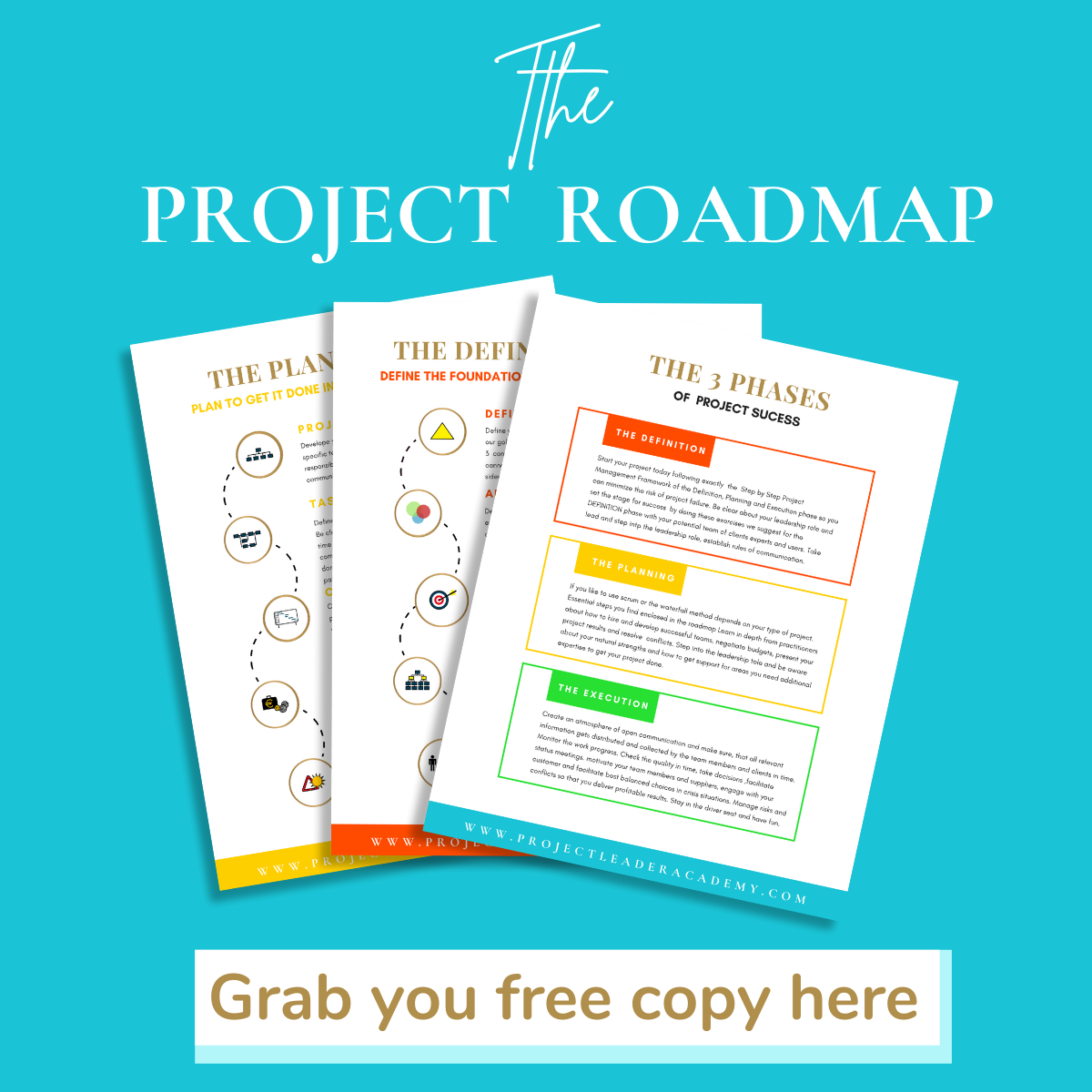
Every AI-generated plan I've ever seen fail didn't fail because it was ugly. It failed because nobody stress-tested it before the money and the deadlines got real. The Project Management Roadmap is what I hand my own clients so that never happens to them — it's the difference between walking into a pitch hoping it goes well, and walking in knowing exactly why it will.
Grab your free Project Management Roadmap here and go into your next project already knowing the answers AI can't give you.
Written by Thea Brockmeyer, Founder of Project Leader Academy. Thea has trained over 10,000 project leaders across 11 countries, including teams inside Fortune 500 companies, drawing on 20+ years of experience in executive sales, negotiation, and complex stakeholder management.
Want more? Here's where to go next:
- Why Do I Need Project Management Skills? — if you're still wondering whether any of this applies to you, start here.
- The 7 Questions You Need to Ask When Starting a Project — the questions I ask before anything else.
- How to Define Project Objectives the Right Way — because "implement the system" isn't an objective, and this shows you what is.
- Stakeholder Management 101: Who They Are and How to Get Their Buy-In — the skill I mentioned above that people underestimate the most.
- The Project Leader Framework — the framework that ties all of this together.
Get your free Project Planning Checklist and make sure your next project is set up for success from the start!