What Is a Stakeholder? How to Identify, Map, and Manage the People Who Decide Your Project's Fate

I once had a contract ready to be signed — and then the board simply did not approve it, because one board member's interests had never been met. Not because the proposal was weak. Because no one had made sure that what he needed was in it. That was the day I stopped treating stakeholders as a list of names to "keep informed" and started treating them as the people who decide whether a project lives or dies.
So let me answer the core question directly, the way I wish someone had answered it for me 25 years ago:
A stakeholder is any individual, group, or organization that can affect — or is affected by — the outcome of your project or business.
Everything else here is what I have learned about finding them, reading them, and managing them so they back your project instead of blocking it — from more than 25 years training over 8,000 leaders across 11 countries, including Fortune 500 teams.
Key takeaways
- A stakeholder is anyone who can affect or is affected by your project — inside or outside your organization.
- The stakeholders who quietly stop projects are almost always the ones nobody mapped.
- I analyze every stakeholder landscape through three lenses: Goals, People, Systems (GPS).
- I use TTI Success Insights DISC to read each person's behavioral style, and SCIL Communication Impact to tailor how I communicate.
- Your real bridge to every stakeholder is communication — mapped, intentional, and consistent.
What is a stakeholder?
A stakeholder is an individual, group, or organization that has a genuine interest in any decision or activity of a project or organization — and who is impacted by its outcome. That "interest" is rarely just the official one. It can be money, time, reputation, career safety, workload, or simply the comfort of not having things change. When I sit down to understand a stakeholder, I am really asking one question: what does this person stand to win or lose if my project goes ahead? Answer that honestly and most of their behavior suddenly makes sense.
Who are the stakeholders in a project?
Stakeholders show up in far more places than the org chart suggests. Typical categories include internal staff and team members; internal management, other departments, and the board; customers, shareholders, investors and end consumers; regulators and communities; suppliers and partners; financial institutions; government and legal authorities — and sometimes even our own family and friends, who carry the emotional cost of our work.

It also helps to split them into internal and external stakeholders, because the two groups need very different handling.

In any project, those people tend to fall into three roles — decision-makers, experts, and users — and your job is to know which is which.

The mistake I see most often is stopping at the obvious names. The stakeholder who derails a project is usually two steps off the official list — the technical expert nobody consulted, the quiet board member, the procurement officer with an unspoken concern.
Why do stakeholders matter so much?
Stakeholders have a direct interest in whether your project succeeds, and they sit both inside and outside the sponsoring organization. They matter because every one of them can push your project forward or hold it back with a single decision. Some are what I call critical or key stakeholders — the people whose support the project literally cannot exist without. Ignore them and you do not get a warning; you get a "no" that arrives, as mine once did, at the worst possible moment.

How do you analyze a stakeholder? My GPS framework
For years I taught this as three dimensions, and today I run every stakeholder landscape through what I call GPS — Goals, People, Systems. It is the same compass I use for the whole business: to navigate, you first need to know where everyone actually stands.
Goals — what does each stakeholder actually want?
Before anything else, I get clear on what each person is trying to achieve. I ask:
- What are this person's business goals — and the goals of their team or organization?
- How does this project affect their personal and career life?
- Who are the real results-drivers here?
In practice, the three most common stakeholder interests are simple: they either benefit (directly or indirectly) from the project's results, they provide resources, or they finance it. The hard part is that these interests conflict. One stakeholder wants chocolate, the other wants vanilla — and your job is to understand the goals behind the positions so you can build a strategy that gives enough people enough of what they need.
People — the relationship and the personality
Business is about people, and most of us are quietly afraid of talking to the very people who could make our project happen. So I map the human side honestly:
- How strong is my relationship with this person, really?
- What is their current state of mind, their pressures, their ambitions?
- How confident do they feel in their own position?
- How does this project affect them emotionally?
To read each person's behavioral style I use TTI Success Insights DISC, the model I am certified in — whether someone leans toward Dominance, Influence, Steadiness, or Conscientiousness changes how I approach them entirely. I've written a full guide on exactly how to do this: How the science of DISC analysis can help you influence stakeholders.
Systems — the tools that make it repeatable
Too many sales managers and business owners copy and paste a generic stakeholder map, never see the real landscape, and lose money by leaving a key person out of the conversation. Systems fix that. The ones I rely on are the stakeholder map, roster, communication plan, RACI matrix, goals tracker, attitude tracker, and the power and influence matrix.

The power and influence matrix above tells me who to manage closely, who to keep satisfied, who to keep informed, and who to simply monitor — so I spend my energy on the people who actually move the project. From there, a simple communication plan keeps every one of them on the right cadence.

How do you communicate with and engage stakeholders?
Once you know the Goals, the People, and the Systems, engagement becomes deliberate instead of hopeful. The tools I reach for again and again are stakeholder meetings, roundtables, win-win negotiations, conferences, and genuine collaboration. This is also where SCIL Communication Impact — my certified communication framework across Sensus, Corpus, Intellectus, and Lingua — does its work, helping me match not just what I say but how I land it for each person.
And here is the most expensive mistake I still watch people make: because we assume a stakeholder is against us, we quietly stop inviting them to the table — and then we are shocked when they surface out of the blue and stop the project cold. Silence is not agreement. The people you are avoiding are exactly the ones to engage first.
How do you manage stakeholders day to day?
A stakeholder is a person like any other member of the project, and the bridge to all of them is communication. I keep that bridge open across whatever channels fit the relationship — in person, email, Slack, Voxer, WhatsApp, webinars, communities, and tools like Monday, Miro, Asana, and Notion to share the project picture in real time. For bigger projects I like to build a dedicated stakeholder community inside the Kajabi community app, where replays, documents, and links live in one findable place so everyone stays current.
One rule I do not bend: whenever possible, meet in person at least once a quarter. Those meetings are where trust compounds, timelines collapse, and the project actually speeds up.
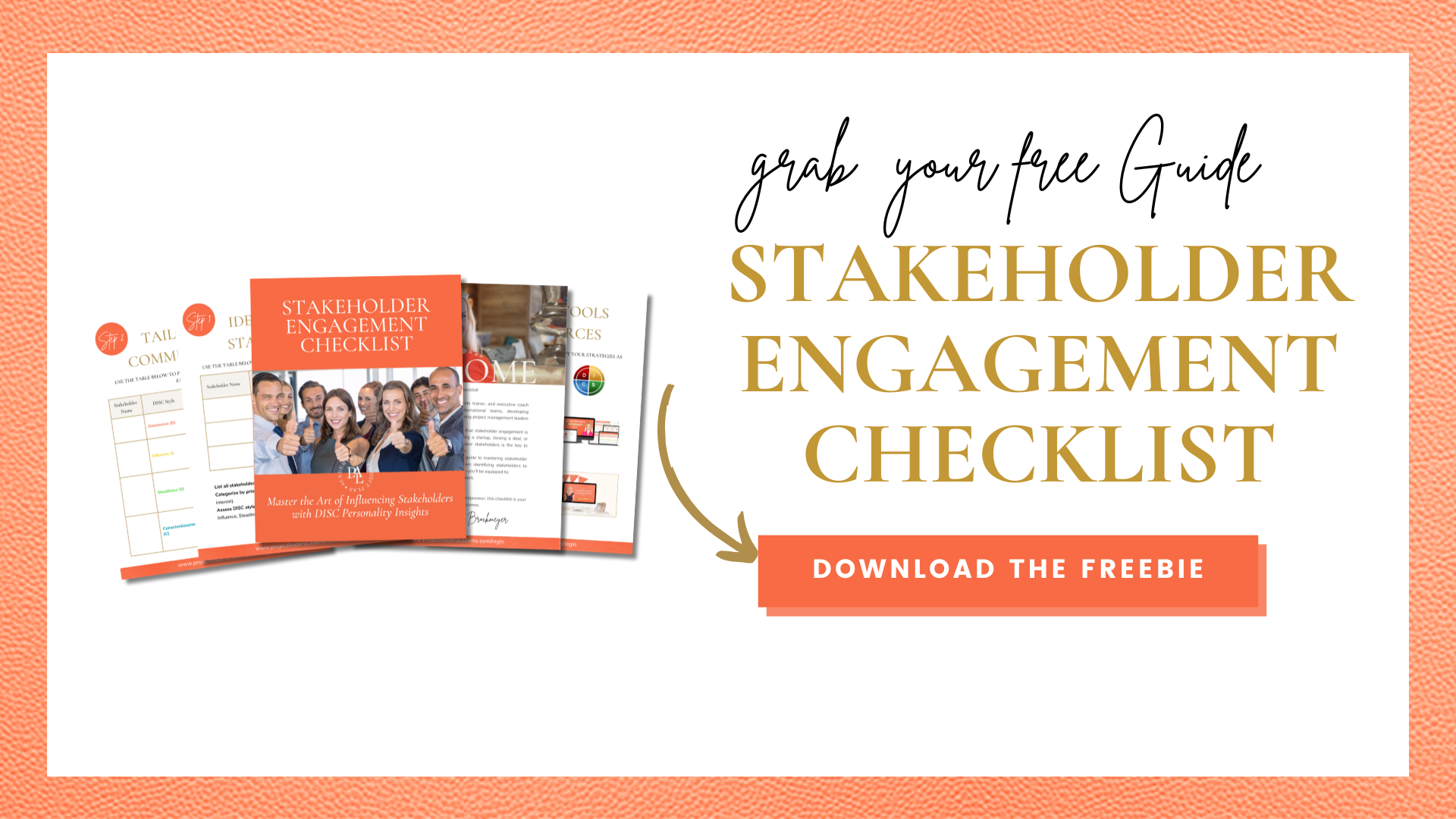
Free download: the Stakeholder Engagement Checklist
If you want a simple, repeatable way to map and prepare for every stakeholder conversation, download my free Stakeholder Engagement Checklist. It walks you through identifying who matters, reading their style, and planning each conversation before you walk in.
Go deeper: the Stakeholder Template Kit
When you are ready for the full system, the Stakeholder Template Kit gives you every template above — map, roster, communication plan, RACI, power and influence matrix — ready for Google, PowerPoint, and Miro. And if your real goal is to win approval for a project, my Project Plan Academy takes you all the way to a board-ready proposal, budget, and pitch.

Frequently asked questions about stakeholders
What is the difference between a stakeholder and a shareholder?
A shareholder owns equity in the company. A stakeholder is anyone affected by or able to affect your project — which includes shareholders, but also staff, customers, suppliers, regulators, and more. Every shareholder is a stakeholder; not every stakeholder is a shareholder.
Who are the most important stakeholders in a project?
The most important are your key stakeholders — the people whose support the project cannot survive without, usually the decision-makers who control approval and funding. But "important" is not only about hierarchy; a mid-level expert with a veto can matter as much as a director.
What is stakeholder mapping?
Stakeholder mapping is the process of listing everyone connected to your project and plotting them — typically by their level of power and their level of interest — so you can see who to manage closely, who to keep satisfied, who to keep informed, and who to simply monitor.
How do I analyze a stakeholder's personality?
I use the TTI Success Insights DISC model to read whether someone is primarily results-driven (D), people-driven (I), stability-driven (S), or detail-driven (C), then adapt my communication to match. You can see the full method in my guide to DISC for stakeholders.
What should I do about a stakeholder who resists the project?
Do not avoid them — engage them early. Most resistance is an unmet need or an unspoken fear. Ask open questions, understand the goal behind their position, and look for a win-win. The stakeholder you ignore is the one who stops the project later.
How often should I update my stakeholder analysis?
Stakeholder influence shifts as projects evolve, so revisit your map at every major milestone and whenever the scope, budget, or key people change. A stakeholder analysis is a living document, not a one-time task.
Keep reading
- How to conduct a full stakeholder analysis, step by step
- How to communicate with your stakeholders effectively
- The three factors behind successful stakeholder engagement
- How the science of DISC analysis can help you influence stakeholders
- How to manage difficult stakeholders
- How to influence silent stakeholders without manipulation